
Score spans and Score runs
A run eval finds the answer wrong; Score spans finds where. Score chosen spans of the run with checks of their own, and route on what they found. In a conversation eval, Score runs does the same for the thread's runs.
A run eval can tell you the answer was wrong. Score spans tells you which step broke it. The step picks spans of the run (the SQL calls, the tool calls, the last retrieval), scores each one with a check, and returns, per check, whether those spans passed or failed. Your routes then send the run to the ending that names the cause: the SQL call failed, a tool reported success but returned nothing.
In a conversation eval the same step is Score runs: it scores runs of the thread instead of spans of a run. Everything below applies to both; read "runs" for "spans". A span eval has no spans of its own to score, so it doesn't offer the step.
Add a check
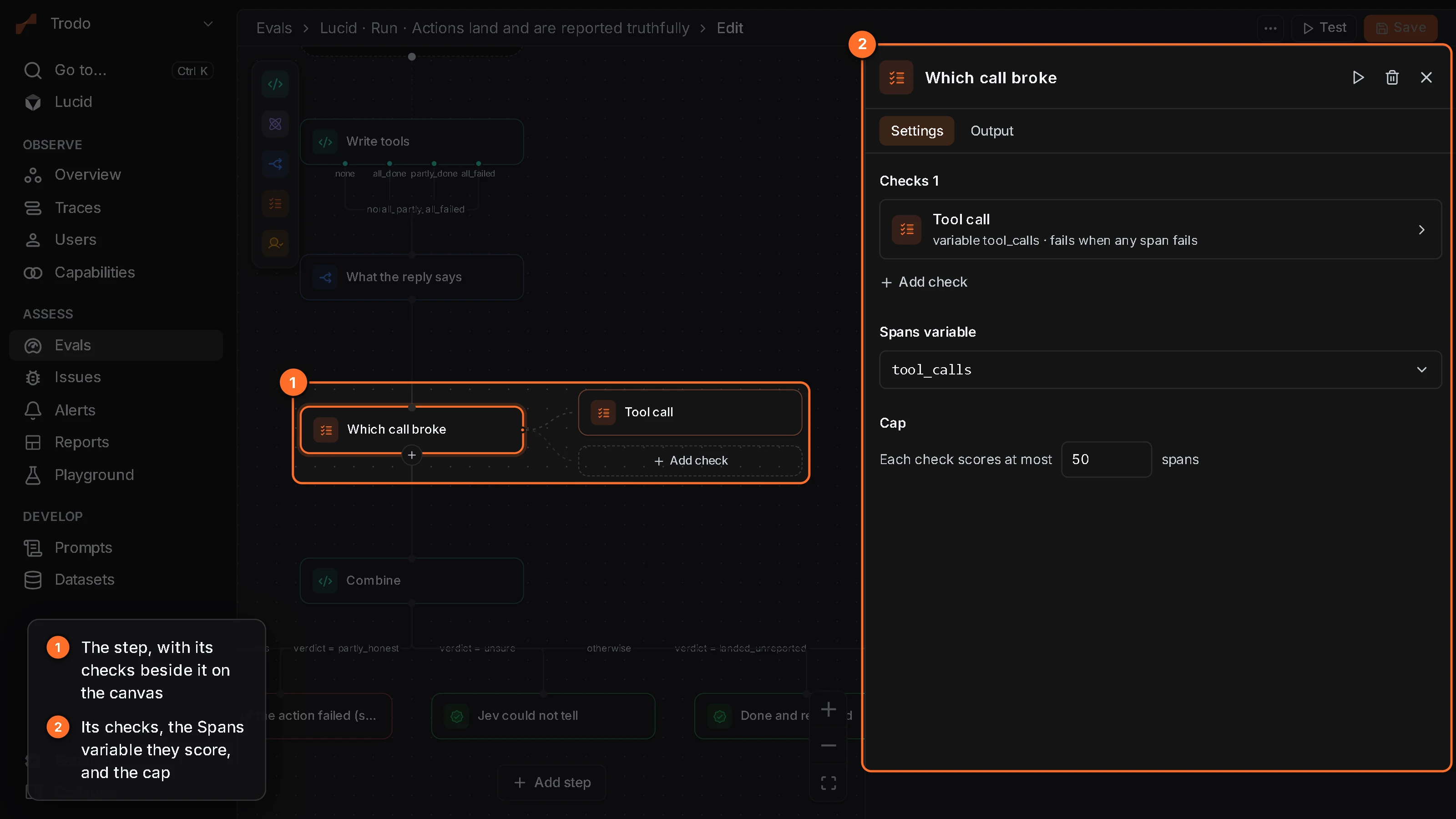
Add Score spans from Add step or the strip on the left of the canvas. Its checks sit in a column beside it on the canvas. Click Add a check (up to 8 per step), then open the check to set it up:
| Setting | What it does |
|---|---|
| Name | The check's name, shown on the canvas and in the routes. |
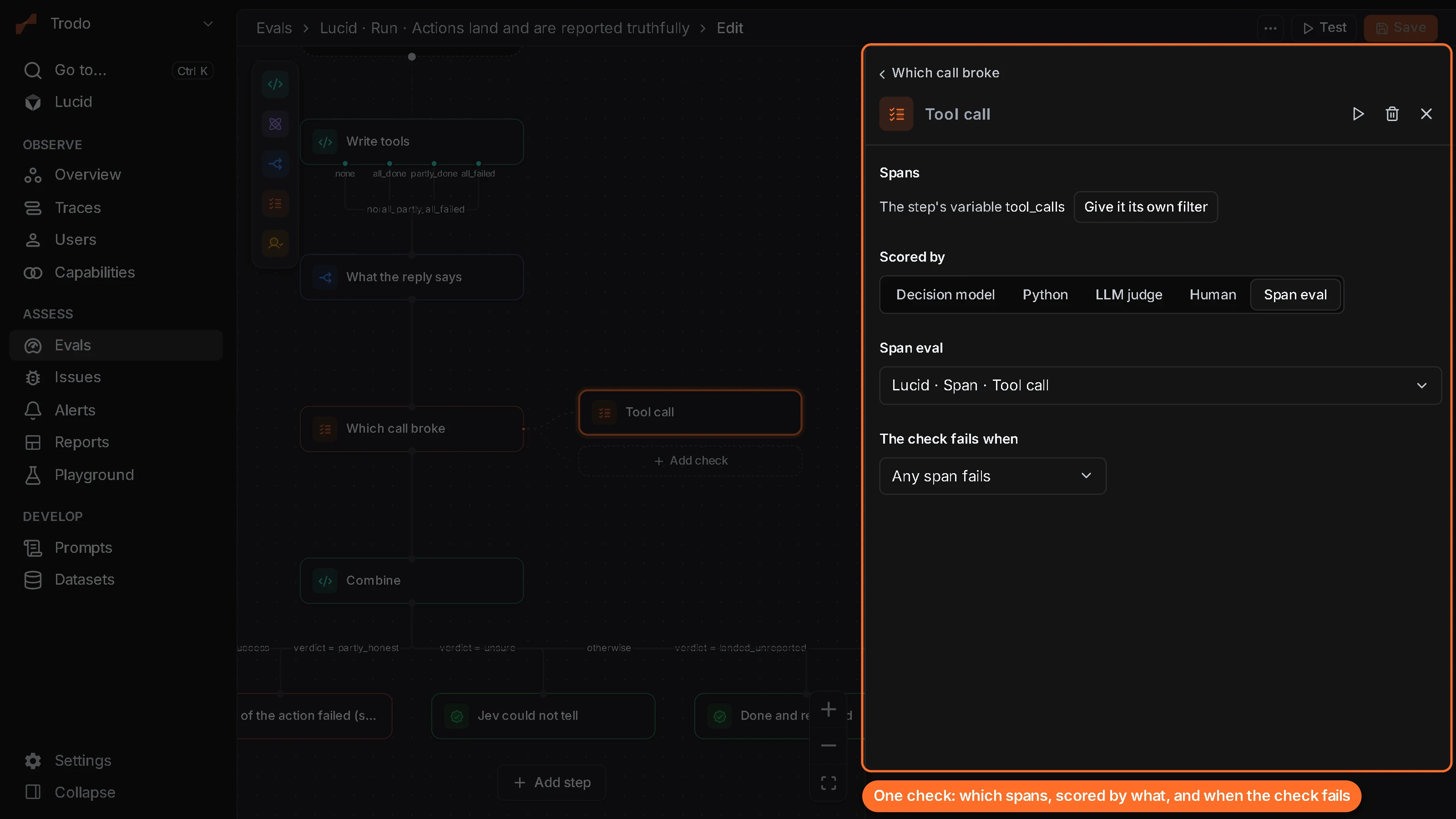
| Spans | Which spans this check scores: Score All of them, The first, The last or The Nth, WHERE filters on the span's name, kind, tool, status and more. Beside the heading, how many recent runs it matched in. A check can instead score the step's Spans variable; Give it its own filter turns that into filters you can edit. |
| Scored by | Decision model, Python, LLM judge, Human, or Span eval (an existing span eval of yours). The first four set up one step right in the check, with where its answers end: A span passes or fails. |
| The check fails when | Any span fails, Every span fails, The last span fails, or N or more fail. |
On the step itself, Cap sets how many spans each check scores at most (20 by default, up to 50). When there are more, the first and the last are kept.
What it returns
For each check, one of three outcomes:
| Outcome | Meaning |
|---|---|
| passed | The spans it scored passed, under its fails-when rule. |
| failed | Enough of them failed. |
| no spans | No span matched, or the span eval applies to none of them. Its own route, never a silent pass. |
It also returns failed_spans and scored_spans, the counts across every check, and passes on failed: which spans failed, under which check, with their reason codes. A later judge reads it as {{steps.<step id>.failed}}, and a Spans variable can be narrowed to Only the ones a Score spans step failed.
On the Output tab, each route reads one or more checks: sql is failed → SQL call failed, otherwise → Combine.
Each span keeps its own verdict
A span scored here is an ordinary result of a span eval, so it shows on that span in Traces. A check you build in the step is kept as a span eval that belongs to this eval: it isn't listed under Evals and isn't scored on its own.
A check that uses an existing span eval reads that eval's result when the span was already scored, so an always-on span eval can be used here with no second cost. To have a span eval run only when a run eval asks for it, set its Sampling to Only when a run eval asks (see Filters and sampling). A span eval that is turned off scores nothing, and the check says so.
While spans are still being scored, the run waits. If a check is scored by a person, the spans wait in the grading queue and the run waits with them, as Waiting. A span that errored decides nothing: if the spans that did resolve already decide the check, it stands; otherwise the step errors and names the span.
Test it
▶ on the step, or Test, scores the spans on the picked trace without saving anything. The check's panel then shows On the test trace: each span it scored and how.
Judges and decision models
Two steps that read meaning. An LLM judge answers your prompt in a declared shape on your own provider key; a decision model answers typed questions with probabilities in one pass.
Human review and the grading queue
Send the cases a model can't settle to a person: the Human review step and its three answer shapes, the grading queue, and spot checks on the cheap steps.