
Setup & cost
Run Lucid on Trodo's models and your Lucid credit, or on one model of your own; set its defaults; and see what it costs.
Lucid works without setup: it runs on Trodo's models and spends your team's Lucid credit. Settings → Lucid setup switches it to a model of your own and sets its defaults. Owners, admins and developers can change it; everyone on the team can see it.
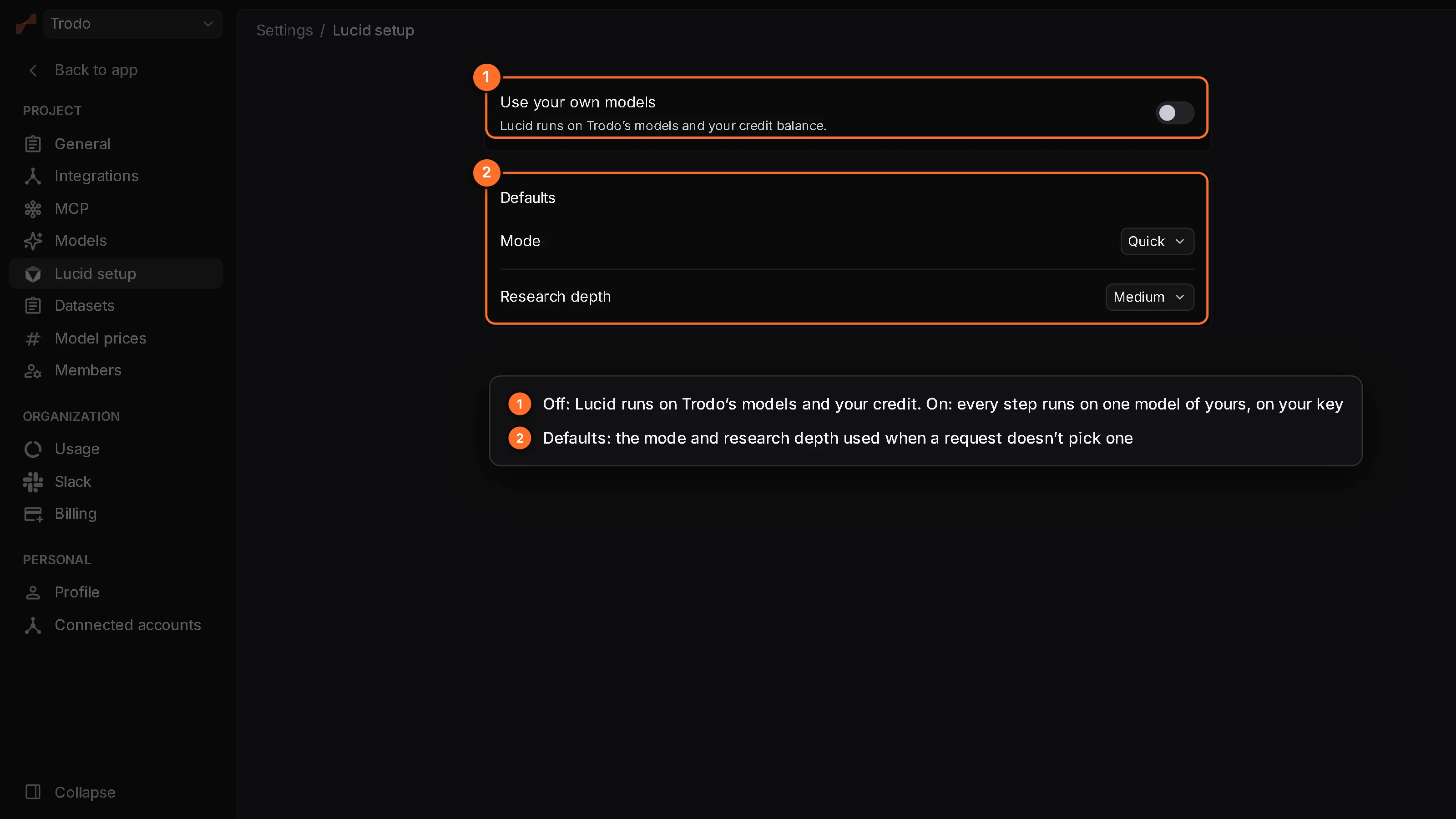
Use your own model
- Add a key for your provider in Settings → Models. See Model providers.
- In Settings → Lucid setup, turn on Use your own models.
- Pick a Provider (one of your keys) and a Model. The models Trodo recommends for answer quality are listed first; any connected model works.
- Click Save. Lucid first runs a short check on the model (a tool call and a structured reply), and saves only if it passes; if not, it shows why.
With it on, every step of Lucid runs on that model, on your key: quick answers, deep research, the decisions inside them and memory. There is no fallback to another key or to Trodo's models, so if your provider is down, Lucid is too. Lucid spends no credit while it's on. Searching your traces by meaning uses Trodo's embeddings either way, at no charge.
Turn the switch off to go back to Trodo's models.
Defaults
| Setting | Options | What it does |
|---|---|---|
| Mode | Quick, Deep research | The mode Lucid uses when a request doesn't choose one. In the chat, the mode chip always chooses, starting on Analyze. |
| Research depth | Low, Medium, High, Max | The effort for deep research when a request doesn't set one. |
What it costs
On Trodo's models, Lucid spends Lucid credit on the model calls it makes. Each plan includes some every month ($2 on Free, $6 on a trial, $30 on Pro), and you can buy more on Settings → Billing. Settings → Usage shows what is left and what Lucid spent each day.
What a question costs depends on the mode and how much data it reads. Deep research costs more with each step up in effort, and stops at three times its estimate (at least $2 at Low, $6 at Medium, $12 at High, $25 at Max).
When the credit runs out, a quick question gets an answer saying so. A deep research run already under way stops and delivers what it had validated as a partial report. Add credit, or switch to your own model.
A Lucid step in an agent spends credit the same way, plus one Execution for the step.
Routines & agents
Run Lucid without anyone at the keyboard: questions on a schedule, and Lucid as a step in an agent that answers, investigates alerts into issues, or improves an eval.
Overview
Evals score every run, span and conversation your agent produces: cheap steps first, a judge or a person only where one is needed, and a proposed fix for what they catch.